Artificial intelligence has turned the traditional call center into a modern, insight-driven customer experience hub. Instead of long queues, repetitive questions, and stressed agents, organizations are using IA en centros de llamadas to deliver faster, smarter, and more personal service at scale. Learn more about how AI transforms call center interactions and CX and why these solutions are critical for modern customer journeys.
AI in call centers enables companies to manage complex customer interactions while improving efficiency and satisfaction. By leveraging emerging cloud computing and AI-powered technology solutions, organizations can process large volumes of customer data in real time, predict customer needs, and deliver more accurate support without overloading human agents. Similarly, cutting-edge high-performance computing platforms for intelligent automation allow businesses to optimize predictive routing, analyze interaction patterns, and improve decision-making across multiple channels.
In the financial sector, AI enhances the ability to provide personalized advice and automate secure transactions. Call centers that utilize advanced financial technology tools for smarter customer account management can ensure faster approvals, reduce errors, and maintain regulatory compliance while offering a seamless customer experience.
Marketing and customer engagement also see major benefits from AI integration. Using insights from long-term online marketing strategies powered by AI analytics, teams can create highly targeted campaigns that resonate with specific customer segments, improving conversion rates and satisfaction. Likewise, strategic digital marketing approaches driven by AI insights for personalized outreach help call centers retain customers and deliver proactive solutions that build loyalty.
By combining intelligent technology, financial tools, and marketing analytics, AI in call centers transforms everyday interactions into meaningful, efficient, and personalized experiences for both customers and agents. Companies can now reduce repetitive tasks, anticipate needs, and provide faster, smarter service at scale, turning the traditional call center into a modern hub for customer satisfaction and operational excellence.
Top AI in Call Center Solutions for Modern Businesses
When it comes to transforming customer support, AI in call centers is redefining how businesses interact with clients. From automating routine inquiries to providing predictive insights, these platforms streamline operations, improve customer experience, and reduce agent workload. Here are the leading AI contact center solutions to consider:
1. Bright Pattern – Comprehensive AI Contact Center Solutions

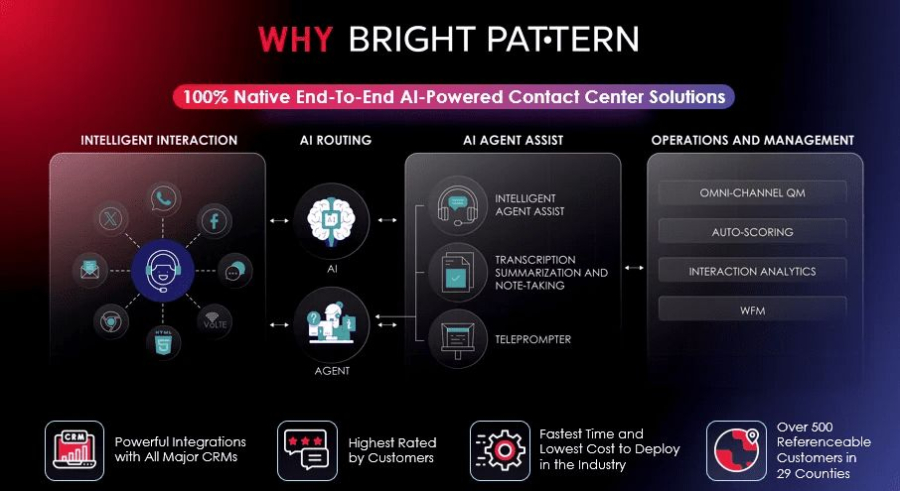
Bright Pattern stands out as a leading platform for organizations seeking advanced AI-powered call center capabilities. It helps businesses deliver seamless omnichannel experiences while automating complex interactions and supporting agents with AI-driven insights.
Key features include:
- AI-driven routing to connect customers with the right agent faster
- Omnichannel support across voice, chat, email, and social media
- Automated workflows to reduce repetitive tasks for agents
- Real-time analytics and reporting for performance optimization
- Predictive customer engagement to anticipate needs and improve satisfaction
Bright Pattern’s AI contact center solutions empower companies to scale operations efficiently while maintaining high-quality, personalized customer interactions.
2. Genesys Cloud CX
Provides cloud-based AI tools for intelligent routing, customer journey analytics, and automated service. Ideal for enterprises looking to optimize multichannel communication.
3. Five9 Intelligent Cloud Contact Center
Offers predictive dialing, AI chatbots, and speech analytics to enhance agent performance and customer satisfaction.
4. NICE inContact CXone
Integrates AI-driven automation, workforce optimization, and omnichannel engagement tools for seamless customer experiences.
5. Talkdesk AI-Powered Contact Center
Combines AI-driven insights, speech analytics, and automation to reduce handling time and improve first-call resolution rates.
6. Amazon Connect
Cloud-based contact center service leveraging AI for natural language understanding, automated call routing, and voice-enabled self-service.
7. Cisco Webex Contact Center
Provides AI-assisted customer service, real-time agent guidance, and predictive analytics to optimize contact center operations.
8. RingCentral Contact Center
Features AI-driven call routing, sentiment analysis, and automation to improve agent efficiency and customer engagement.
9. 8x8 Contact Center
Delivers omnichannel AI solutions, including chatbots, predictive analytics, and performance dashboards for effective customer support.
10. Twilio Flex
Customizable cloud contact center platform with AI capabilities for task routing, automation, and analytics across multiple channels.
What Is AI in Call Centers?
AI in call centersrefers to a set of technologies that understand, analyze, and respond to customer interactions across voice and digital channels. These tools do more than automate simple tasks; they assist agents, surface insights, and continuously improve service quality.
Common AI capabilities include:
- Natural language processing (NLP)for understanding spoken and written customer queries.
- Machine learning (ML)to predict intent, next best action, and likely outcomes.
- Generative AIto draft responses, summarize conversations, and create knowledge content.
- Speech analyticsto analyze call recordings and live audio in real time.
- Intelligent routingto match customers with the best available resource.
When combined, these capabilities unlock a new level of efficiency and customer satisfaction that manual processes cannot match.
Key AI Use Cases in Modern Call Centers
AI is already reshaping daily operations in call centers. Below are the most impactful use cases and how they translate into measurable value.
1. AI-Powered Virtual Agents and Chatbots
AI virtual agents handle common customer requests automatically, across channels like voice, chat, and messaging. They understand intent, ask clarifying questions, and complete tasks end to end.
Typical examples include:
- Checking account balances, orders, or reservations.
- Resetting passwords or updating contact details.
- Providing delivery status and estimated arrival times.
- Answering product, billing, or policy questions.
Benefits:
- 24/7 availabilitywithout requiring additional staffing.
- Shorter wait timesbecause routine inquiries never enter the live queue.
- Consistent, compliant responsesbased on approved knowledge content.
- Lower cost per contactwhile maintaining or improving quality.
2. Agent Assist: AI as a Real-Time Co‑Pilot
Agent assist tools listen to or read ongoing interactions and provide real-time guidance on the agent desktop. Instead of searching multiple systems, agents see contextual suggestions instantly.
Agent assist can:
- Surface relevant knowledge articles as the customer speaks.
- Suggest next best actions or offers based on customer history.
- Auto-fill forms and summarize key call details.
- Flag potential compliance risks or escalation signals.
Benefits:
- Faster handle timesbecause agents spend less time searching and typing.
- Higher first contact resolutionas the right answers appear proactively.
- Shorter training curvesfor new hires who get guidance in the moment.
- More confident agentswho focus on empathy and problem solving, not admin work.
3. Intelligent Routing and Prioritization
AI-enhanced routing goes beyond simple skills-based rules. It predicts what a customer needs and directs them to thebestresource to handle that specific request.
AI routing can account for:
- Customer intent inferred from words, behavior, or channel.
- Customer value or risk indicators, such as loyalty status or churn risk.
- Agent performance metrics and specialized expertise.
- Real-time queue conditions and service level targets.
Benefits:
- Improved customer satisfactionbecause callers reach the right expert faster.
- Better use of talentby aligning complex cases with top performers.
- More stable service levelsthanks to dynamic routing based on current demand.
4. AI-Driven Quality Assurance and Coaching
Traditional quality assurance (QA) teams can only review a small sample of calls. AI changes this by automatically analyzing100% of interactionsacross voice and digital channels.
Quality AI typically evaluates:
- Use of required greetings, disclosures, and compliance statements.
- Customer sentiment and emotional tone over the course of a call.
- Agent soft skills, such as empathy, active listening, and clarity.
- Adherence to process, scripts, or regulatory guidelines.
Benefits:
- Complete visibilityinto performance trends and coaching needs.
- Fairer, more consistent scoringthan manual sampling alone.
- Targeted, data-driven coachingaligned with actual behaviors, not assumptions.
- Stronger compliance assurancewith automatic alerts for potential issues.
5. Analytics, Forecasting, and Workforce Optimization
AI thrives on large data sets, making it ideal for forecasting and workforce planning. It helps managers align staffing, skills, and resources with real demand patterns.
AI can support workforce teams by:
- Predicting contact volumes by channel, time, and customer segment.
- Identifying emerging topics that might drive spikes in demand.
- Optimizing schedules to meet service level targets at lower cost.
- Highlighting process bottlenecks and improvement opportunities.
Benefits:
- More accurate forecaststhat reduce under- and over-staffing.
- Lower operational costswith minimal impact on service quality.
- Happier employeesthrough more predictable workloads and schedules.
6. Generative AI for Summaries and Knowledge
Generative AI excels at turning unstructured conversation data into concise, useful content. In call centers, this means faster documentation and smarter knowledge bases.
Common applications include:
- Auto-generated call summaries and case notes.
- Drafting follow-up emails or confirmations for agent review.
- Creating or updating knowledge articles based on recurring questions.
- Summarizing long interaction histories into quick briefings for agents.
Benefits:
- Less after-call work (ACW), allowing agents to take more calls without burnout.
- Higher data qualitythanks to structured, consistent summaries.
- Continuously improving knowledgethat reflects real customer language and needs.
Business Benefits of AI in Call Centers
AI is not just a technology upgrade; it is a business strategy that directly supports growth, loyalty, and profitability. The most common benefits include:
1. Better Customer Experience
- Faster resolutions :Intelligent self-service and agent assist reduce wait and handling times.
- More personalization :AI uses customer data to tailor offers, messages, and recommendations.
- Omnichannel consistency :Customers get accurate, aligned answers across voice, chat, and messaging.
2. Higher Agent Productivity and Engagement
- Less repetitive work :AI handles routine interactions and admin tasks.
- More meaningful conversations :Agents focus on complex issues and relationship building.
- Better coaching :Data-driven feedback supports growth and confidence.
3. Lower Cost per Contact
- Automation of high-volume querieskeeps headcount stable as demand grows.
- Optimized staffingthrough AI forecasting reduces overtime and idle time.
- Fewer escalations and callbacksthanks to higher first contact resolution.
4. Deeper Insight into Customer Needs
- Voice of the customer at scale :Speech and text analytics reveal trends and pain points.
- Product and policy feedback :Real customer language informs improvements.
- Cross-functional impact :Insights support marketing, product, and operations teams.
Comparing Traditional vs. AI-Enhanced Call Centers
The table below highlights how AI changes core aspects of contact center operations.
Dimension | Traditional Call Center | AI-Enhanced Call Center |
Customer Access | Limited hours, phone-dominant | 24/7, voice and digital self-service plus live support |
Agent Support | Static scripts, manual search | Real-time guidance, dynamic suggestions, auto-summaries |
Quality Monitoring | Sampled calls, manual review | Near 100% coverage with automated scoring and insights |
Routing | Basic rules and skills-based assignment | Predictive, context-aware routing based on intent and value |
Forecasting | Historical averages, limited variables | AI-driven forecasts using multiple data signals |
Scalability | Proportional staffing required as volume grows | Automation absorbs growth with modest staffing changes |
Practical Steps to Implement AI in Your Call Center
Successful AI adoption is less about flashy features and more about thoughtful execution. The following steps help you build a strong, low-risk foundation.
1. Clarify Business Objectives and Metrics
Start with measurable goals, such as:
- Reducing average handle time by a specific percentage.
- Improving customer satisfaction or net promoter scores.
- Increasing self-service containment rates.
- Lowering cost per contact while maintaining quality.
Clear objectives guide technology choices and make it easier to demonstrate ROI.
2. Prioritize High-Impact Use Cases
Look for areas where AI can deliver rapid, visible wins. Common starting points include:
- Virtual agents for the most frequent, simple inquiries.
- Agent assist for complex, high-value call types.
- Speech analytics for quality and compliance monitoring.
Focusing on a few targeted use cases builds momentum and reduces change fatigue.
3. Prepare Your Data and Knowledge
AI performance depends heavily on the data it learns from. To set up for success:
- Consolidate and clean customer and interaction data where possible.
- Review knowledge articles for accuracy, clarity, and consistency.
- Identify any sensitive data that must be protected or masked.
4. Engage and Support Your Agents
Agents are at the heart of AI success. Position AI as a co‑pilot, not a replacement, by:
- Explaining how AI will remove tedious work and support better conversations.
- Involving agents in pilot programs and gathering their feedback.
- Offering training that builds confidence in using new tools.
When agents trust the technology, they champion it and help unlock its full value.
5. Start with Pilots, Then Scale
Run limited pilots to validate assumptions and fine-tune models before full rollout:
- Choose a specific queue, region, or product line.
- Set clear success criteria and compare performance with control groups.
- Adjust configurations, knowledge content, and workflows based on results.
Once the pilot performs well, expand to new use cases and channels.
6. Monitor, Optimize, and Evolve
AI solutions improve over time. Make optimization an ongoing practice by:
- Reviewing performance dashboards regularly.
- Updating intents, routing rules, and knowledge articles.
- Capturing feedback from agents, customers, and supervisors.
A continuous improvement mindset keeps your AI aligned with changing customer expectations and business priorities.
Key Metrics to Track AI Impact
To prove and expand the business case for AI, track both operational and experience metrics.
Operational Metrics
- Average handle time (AHT)for both live and AI-assisted interactions.
- First contact resolution (FCR)rates.
- Self-service containment(percentage of contacts fully resolved via automation).
- Cost per contactby channel.
- Agent occupancy and utilizationlevels.
Experience and Quality Metrics
- Customer satisfaction (CSAT)and net promoter score.
- Customer effort scorefor key journeys.
- Quality scoresfrom AI and human evaluations.
- Agent engagementand retention rates.
The Future of AI in Call Centers
AI in call centers is still evolving, but several trends are already reshaping what is possible.
- More conversational self-service :Virtual agents will feel increasingly natural and context-aware.
- Unified customer journeys :AI will knit together data from sales, service, and marketing to eliminate repetition.
- Proactive outreach :Instead of waiting for customers to call, AI will trigger timely, helpful notifications and offers.
- Deeper human-AI collaboration :Agents will rely on AI not only for information, but also for coaching and decision support.
The result is a contact center that is no longer viewed as a cost center, but as a strategic engine for loyalty, insight, and growth.
Conclusion: Turning AI into a Call Center Advantage
AI gives call centers the power to respond faster, resolve more, and build stronger relationships at scale. By combining virtual agents, real-time agent assist, intelligent routing, and analytics, organizations can create a service experience that is both highly efficient and deeply human.
For leaders, the opportunity is clear: define your goals, start with focused use cases, and bring your people along on the journey. With the right approach, AI becomes less about replacing humans and more about empowering them to deliver the kind of customer experience that keeps people coming back.
